
Manufacturing & Quality
In-Process vs Pre-Shipment Inspection for Sunglasses Orders
This guide explains how during-production (DUPRO) and pre-shipment (PSI) inspections fit into an OEM or ODM sunglasses quality plan. It compares scope, timing, what each stage catches, how AQL sampling is agreed, and how B2B buyers can structure checkpoints per order.What each inspection stage means
Article summary: This guide explains how during-production (DUPRO) and pre-shipment (PSI) inspections fit into an OEM or ODM sunglasses quality plan. It compares scope, timing, what each stage catches, how AQL sampling is agreed, and how B2B buyers can structure checkpoints per order.

Quality outcomes on a sunglasses order rarely depend on a single inspection. They depend on how specifications, references, in-process checks and final verification are sequenced across the production window. For B2B buyers placing OEM or ODM orders, the two most common third-party checkpoints are in-process (DUPRO) inspection and pre-shipment inspection (PSI). Choosing where each fits, and what each is expected to catch, is part of the order plan you agree with the factory before production starts.
This article walks through the definitions, the trade-offs, and a practical way to decide when DUPRO adds value, when PSI alone may be reasonable, and how to write these checkpoints into an RFQ or PO.
Is DUPRO always necessary if we already plan a PSI?
No. DUPRO adds value when the risk profile of the order — new tooling, new decoration, changed materials, tight lead times — makes mid-run correction meaningfully cheaper or safer than end-of-run rework. For stable repeat styles, PSI may be sufficient.
Can PSI substitute for compliance testing?
No. PSI verifies workmanship, packing and conformity to the specification and reference sample using an agreed sampling plan. Product-specific compliance testing follows separate standards, samples and laboratory procedures, and its scope depends on the product and destination market.
Who chooses the AQL numbers? The buyer and factory agree them together before production, referenced to a named standard such as ISO 2859-1 or ANSI/ASQ Z1.4. The agreement should cover inspection level, defect classes and the acceptance and rejection numbers, not just a single figure. What happens if PSI fails? Options depend on the finding and the agreed procedure: rework the affected units, 100% sort, accept with a documented concession, or reject the lot and re-inspect after rework. Cost and lead-time responsibility should be set out in the PO before the situation arises. Can DOMI arrange the third-party inspection for us? Third-party inspection is buyer-appointed. DOMI supports the process by making production, samples, documents and access available for the agreed scope, timing and sampling plan. In-process (DUPRO) inspection. DUPRO — During Production — is carried out while a portion of the order is complete and the balance is still in production, or while components are still being assembled. The point of the timing is corrective action: findings can feed back into tooling, injection, coating, printing, hinge assembly or lens fitting before the rest of the lot is finished. DUPRO typically reviews: Because production is still moving, the inspector's report is most useful when it triggers a documented corrective action rather than only a pass/fail statement. Pre-shipment (PSI) inspection. PSI is performed when the lot is finished and packed, or substantially so, and ready to leave the factory. It verifies the completed goods against the specification, the approved sample and the packing list. The inspector draws samples from the packed cartons using an agreed sampling plan, checks workmanship, function, dimensions, markings and packing, and issues a report the buyer uses to authorize shipment. PSI is the last practical opportunity to hold a shipment before it leaves the origin. It is not a substitute for product-specific compliance testing, and it does not replace the buyer's own approval of pre-production and shipment samples.
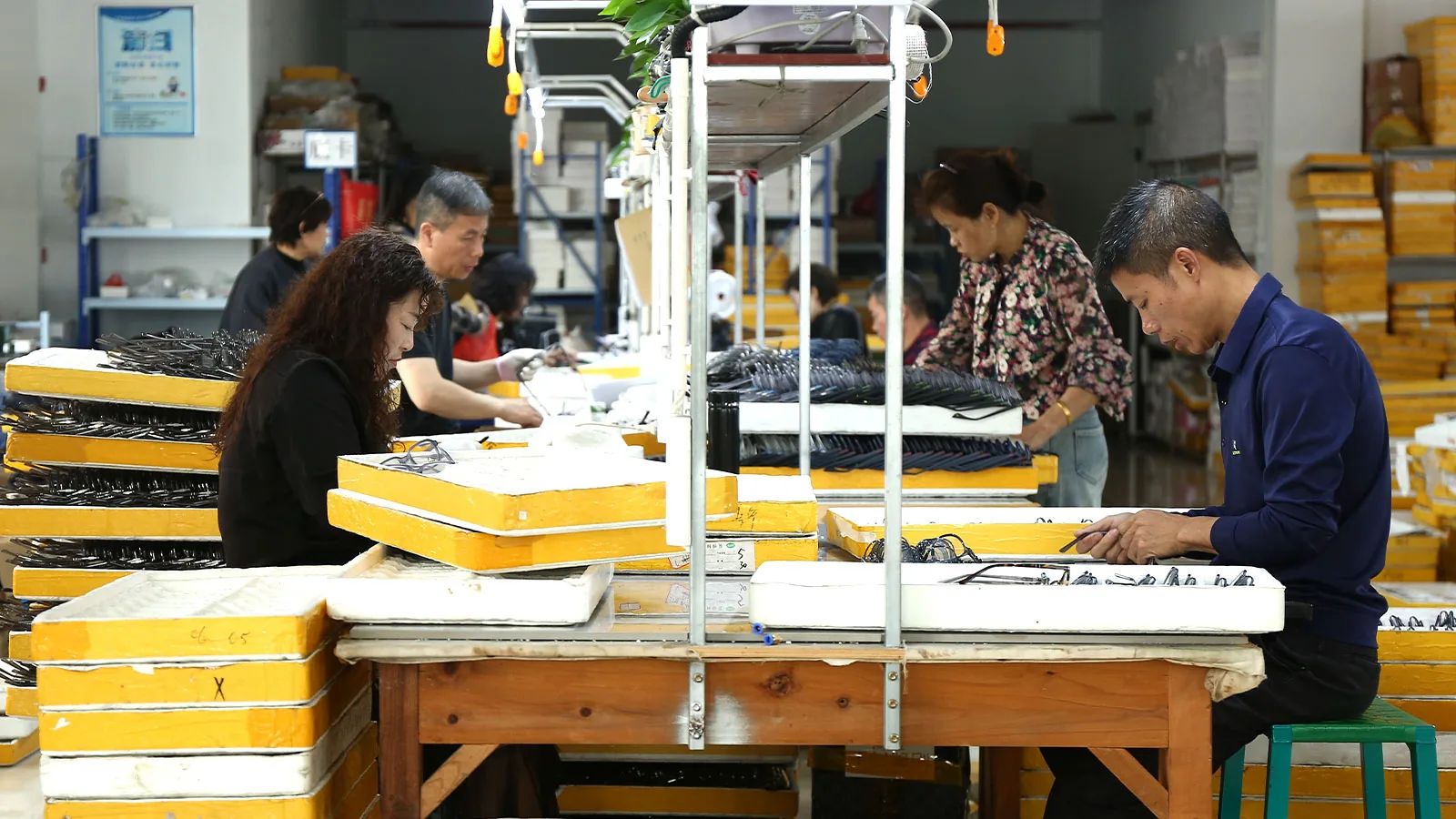
- Frames already molded, tumbled, painted or plated
- Lens preparation, coatings and fit into the frame
- Hinge assembly, screw torque feel and alignment
- Print, pad print or laser marking against the approved artwork
- Labeling, logo placement and color match to the reference sample
- Early packaging samples if pouches, cases or cartons are on site
Where each stage fits in a sunglasses order
Production sequences vary by material, decoration and factory layout, so there is no universal percentage of completion at which DUPRO must occur. Acetate, metal, injection-molded polymers and mixed-material builds each move through different stations. Booking thresholds — how much of the lot must be finished, how many components must be available, how packing must be progressed — are agreed order by order.
A workable way to think about it:
The DOMI manufacturing and quality overview explains how OEM and ODM projects are structured; the inspection plan sits alongside that structure rather than replacing internal checks.
- Before production: buyer approves specifications, artwork, colors, reference samples and packaging. Compliance testing scope is agreed.
- Early production: first-off samples from the running line confirm the reference is being reproduced.
- DUPRO: partial output is available, corrective action is still feasible on the balance.
- PSI: lot is finished and packed, sampling verifies the completed goods.
- After shipment: receiving inspection at the buyer's warehouse or distribution center.
What each inspection typically catches, and what it can miss
Neither stage substitutes for laboratory testing where a product or destination market calls for it (for example, checks that may apply to UV performance, impact resistance, nickel release or restricted substances). Named standards such as EN ISO 12312-1 in the EU, the FDA's impact requirement for sunglasses in the US, or AS/NZS 1067 in Australia and New Zealand may be relevant depending on the product, its claims and where it will be sold — these should be verified per order and per market, not assumed.
- DUPRO strengths. Detects tooling, mold or setup issues while they can still be corrected
- Identifies color, coating or print drift before the full lot is produced
- Surfaces assembly problems (hinge play, lens seating, screw fit) mid-run
- Gives the buyer time to decide on rework, sorting or re-production
- DUPRO limitations. Only reviews what is available on the day; late-stage defects are out of scope
- Cannot verify final packing, carton marks or shipment quantities
- Sampling is opportunistic across work-in-progress, not the finished lot
- PSI strengths. Verifies the completed, packed lot against the specification
- Confirms quantities, carton marks, barcodes, inserts and packaging
- Applies a formal sampling plan against defect classes
- Produces the report used to release the shipment
- PSI limitations. If serious issues appear, options are narrower: rework, sorting, hold or reject
DUPRO and PSI comparison
Use this matrix to separate the purpose of each checkpoint before agreeing the inspection scope.
| Aspect | In-process (DUPRO) | Pre-shipment (PSI) |
|---|---|---|
| Timing | While production is running | After the lot is finished and packed |
| Primary purpose | Enable corrective action | Verify finished goods before release |
| Typical scope | Work in progress, components and early output | Packed cartons, sampled units and packing list |
| Sampling basis | Available work in progress under the agreed scope | Agreed sampling plan against the finished lot |
| Packaging check | Limited or partial | Includes final packing, carton marks and inserts |
| If defects are found | Adjust the process, rework or sort remaining output | Hold, sort, rework or reject under the agreed procedure |
| Replaces lab testing | No | No |
Selecting checkpoints by product and process risk
Not every order needs the same checkpoints. A reorder of a stable style with unchanged artwork carries different risk from a new mold, a new coating, or a first run with a new decoration technique. Useful risk signals include:
Higher risk on any of these usually justifies a DUPRO on top of PSI. Lower risk on repeat orders may justify PSI alone, provided the reference sample and specification are unchanged.
The sunglasses factory audit checklist and the OEM sunglasses project checklist are useful when scoping which risks apply to your specific project.
- New tooling or first production from a mold
- New decoration: pad print, laser mark, hot stamp, water transfer, new color
- Material or component change: different acetate sheet, new hinge, new lens supplier
- Packaging complexity: retail-ready cases, gift sets, printed sleeves, region-specific inserts
- Regulatory sensitivity: children's sunglasses, prescription-ready frames, sport or safety claims
- Order size and channel: retail launch windows, marketplace listings with photo compliance
AQL sampling, described carefully
AQL — Acceptable Quality Limit — is not a single number. It is a sampling framework, most often referenced to ISO 2859-1 or ANSI/ASQ Z1.4, and it must be defined for each order. A workable AQL agreement between buyer and factory typically covers:
Numeric limits for major and minor defects vary by buyer, product category, channel and risk tolerance. There is no universal figure that applies to all sunglasses orders. What matters is that the numbers are agreed in writing, referenced to the standard, and applied consistently by whoever performs the inspection.
Defect classification examples for sunglasses. These are illustrative and should be tuned to your specification:
Classification is only useful if the reference sample and specification make the boundaries clear.
- The named standard and edition being followed
- The lot size the sample will be drawn from
- The inspection level (general or special)
- The defect classes — commonly critical, major and minor — with plain-language examples for the product
- The acceptance and rejection numbers for each class, derived from the standard once the level and limit are chosen
- What happens on borderline or ambiguous findings
- Critical: hazards such as sharp edges, broken components, mislabeling that could mislead on safety or origin
- Major: defects likely to affect function or saleability — lens scratches in the field of view, misaligned hinges, wrong print color, wrong carton contents
- Minor: cosmetic issues within tolerance boundaries that would not typically be returned by end users
Buyer-owned specification and reference samples
Both DUPRO and PSI depend on documents the buyer owns. Without them, inspectors default to generic workmanship judgments that may not match what the buyer expects.
Recommended documents to lock before production:
The stronger these references, the more consistent DUPRO and PSI outcomes will be.
- Approved golden sample (signed and dated by both parties)
- Written specification: dimensions with tolerances, materials, lens category, coatings, hardware
- Artwork files for prints and laser marks with position and size
- Color standards (Pantone or physical chips) for frame, print and packaging
- Packaging drawings and carton marking rules
- Compliance testing scope for the destination market, if applicable
- Defect boundary samples — accepted and rejected examples where possible
Handling findings and corrective action
An inspection report is only useful if it drives a decision. A practical workflow:
Cost responsibility for re-inspection, rework and delayed shipment is a commercial matter that should be defined in the PO or supply agreement, not decided during the dispute.
- Inspector issues the report with photos and measurements against the specification.
- Buyer reviews classification and confirms whether they agree with the calls.
- If the lot fails on the agreed AQL plan, options are: rework, 100% sorting, partial acceptance with concessions, or rejection.
- Root cause is documented, not just the symptom, particularly for DUPRO findings.
- Corrective actions are agreed with a target date and a verification method.
- If PSI failed, re-inspection scope and cost responsibility are agreed before shipment is released.
Third-party inspection: roles and responsibilities
Buyer-appointed third-party inspection can provide an independent check, but its usefulness depends on an agreed scope. DOMI can accommodate buyer-appointed third-party pre-shipment inspection when the sampling plan, timing, access and cost responsibility are confirmed in advance. Other checkpoints should be discussed for the specific order. Points worth clarifying before the inspection date:
Some buyers use their own QA staff, some use inspection agencies, some combine both. The factory's role is to make production, samples, packing and documentation available for the agreed scope.
- Who books the inspection and by when
- What documents the inspector receives (specification, golden sample photos, artwork, packing list)
- What the inspector is authorized to check and to decide
- Access arrangements at the factory
- Report format and delivery time
- How disputes over classification are resolved
- Who pays for re-inspection if the first visit fails
Practical checklist for RFQ and PO
Items worth including before production starts:
- Product specification and approved golden sample identified by revision and date
- Packaging specification and carton marking rules
- Named AQL standard, inspection level, defect classes, acceptance/rejection numbers
- Whether DUPRO, PSI or both are planned
- Booking thresholds for each inspection
- Who appoints and pays the inspector
- Compliance testing scope, laboratory and cost responsibility for the destination market
- Rework, sorting, concession and rejection procedure
- Re-inspection responsibility and cost
- Shipment release authority — who signs off after PSI
When PSI alone may be reasonable, and when a hybrid plan is stronger
PSI alone can be a reasonable plan when the style is a stable repeat, the mold and decoration are unchanged, the packaging is unchanged, the specification and reference sample are locked, and the compliance scope is already established from earlier production.
A hybrid DUPRO plus PSI plan tends to be more useful when:
The choice is a risk and cost judgment, made per order.
- The mold is new or has been modified
- Decoration, color or artwork has changed
- Materials or key components have changed
- Packaging is new or region-specific
- The order is large enough that mid-run correction is materially cheaper than end-of-run rework
- Lead time is tight and a failed PSI would put the shipment window at risk
About DOMI
DOMI Eyewear has provided sunglasses manufacturing and customer service since 2008. The factory maintains more than 300 existing molds, has approximately 5 million pairs of annual capacity, and supports custom and bulk OEM, ODM and private-label programs. Buyer-appointed third-party pre-shipment inspection can be accommodated when scope, sampling plan, timing and cost responsibility are agreed in advance; any additional inspection stage should be confirmed for the order.
A restrained closing note
Inspections do not create quality; they verify it. The core of a reliable sunglasses order is a locked specification, an approved reference sample, a defined compliance scope, and clear communication between buyer and factory. DUPRO and PSI are tools within that structure — one to correct while there is still time, one to verify before the goods leave. Choose the combination that matches the risk of the specific order, write it into the PO, and apply it consistently.
If you are scoping a new project, the OEM sunglasses project checklist and sunglasses factory audit checklist may be useful references while you draft your inspection plan.
FREQUENTLY ASKED QUESTIONS
Questions Buyers Often Ask
Is DUPRO always necessary if we already plan a PSI?
No. DUPRO adds value when new tooling, decoration, materials or timing make mid-run correction useful. For a stable repeat style with locked references, PSI may be sufficient.
Can PSI substitute for compliance testing?
No. PSI verifies workmanship, packing and conformity to the approved specification. Product-specific compliance testing follows a separate scope based on the product and destination market.
Who chooses the AQL numbers?
The buyer and factory agree the sampling standard, inspection level, defect classes and acceptance or rejection numbers before production. A single generic figure is not enough.
What happens if PSI fails?
The agreed procedure may require rework, sorting, a documented concession or rejection followed by re-inspection. Cost and schedule responsibility should be defined in the purchase order.
Can DOMI arrange the third-party inspection for us?
Third-party pre-shipment inspection is buyer-appointed. DOMI can make the order, samples, documents and factory access available when scope, timing, sampling plan and cost responsibility are agreed in advance.
PLANNING A SUNGLASSES PROJECT?
Turn the Guide Into a Clear Project Brief
Send DOMI your target style, quantity, artwork and delivery requirements.
Manufacturing & Quality
Sunglasses Factory Audit Checklist
Read article →
Buying Guides
OEM Sunglasses Project Checklist: What to Prepare Before Sampling
Read article →
Manufacturing & Quality